
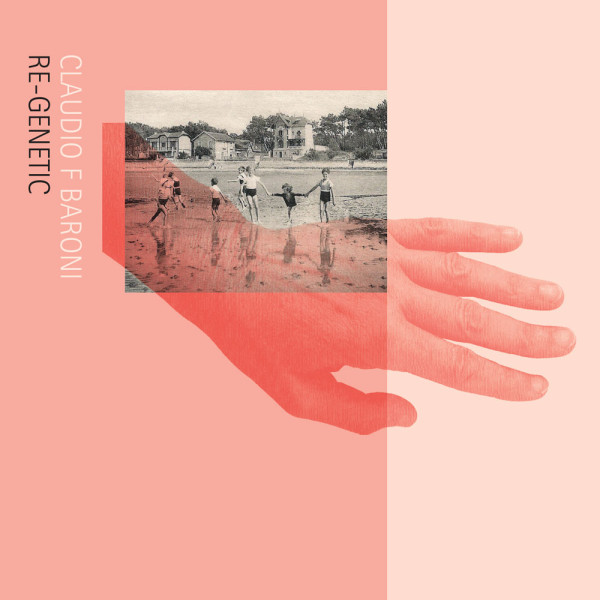
In the two works on this album, Netherlands-based Argentine composer Claudio F. Baroni sets recorded speech against acoustic and electronic pitched sounds. The instrumental material emerges entirely from digitally aided speech analysis, which identifies occurrences of Western scale pitches within the natural intonations of speech. From these pitches, Baroni selects and assigns certain tones to instruments and electronics. The scores consist of the written speech text paired with musical notes, precisely aligned with the syllables from which they were drawn. Performers listen to the recorded speech and play the notes accordingly, resulting in instrumental sounds that synchronously “shadow” the speech.
J’ai Connu features an excerpt from “Essay Mémoire Xxe” (2022) by essayist Géraldine Schwarz. Re-Genetic Mutations incorporates the full original recording of Robert Ashley’s solo voice piece “Love Is A Good Example” (1991). Baroni engages with those two sophisticated and radical texts, yet his listening is not focused on their semantic registers. He does not interpret, comment, explain, reinforce, conceptualise, or illustrate the meaning they narrate. In this sense, the semantic integrity of the texts remains untouched by sound. Instead, by drawing out the musicality of speech, the composer loosens words from their primary function as semantic vessels and highlights them as temporal and sonorous events. By closely following the sonorities of speech and subtly playing along, his compostional principle constitutes a materialised act of listening.
J'ai Connu (excerpt)
Re-Genetic Mutations (excerpt)
Programme Notes
Composition as Materialised Listening
Claudio F. Baroni lends his ear to the spoken words and gently touches them with sound. By closely following the sonoroties of speech and subtly playing along, his compositional principle constitutes a materialised act of listening. He invites us — the second listeners — to join him in this heightened state of attention.
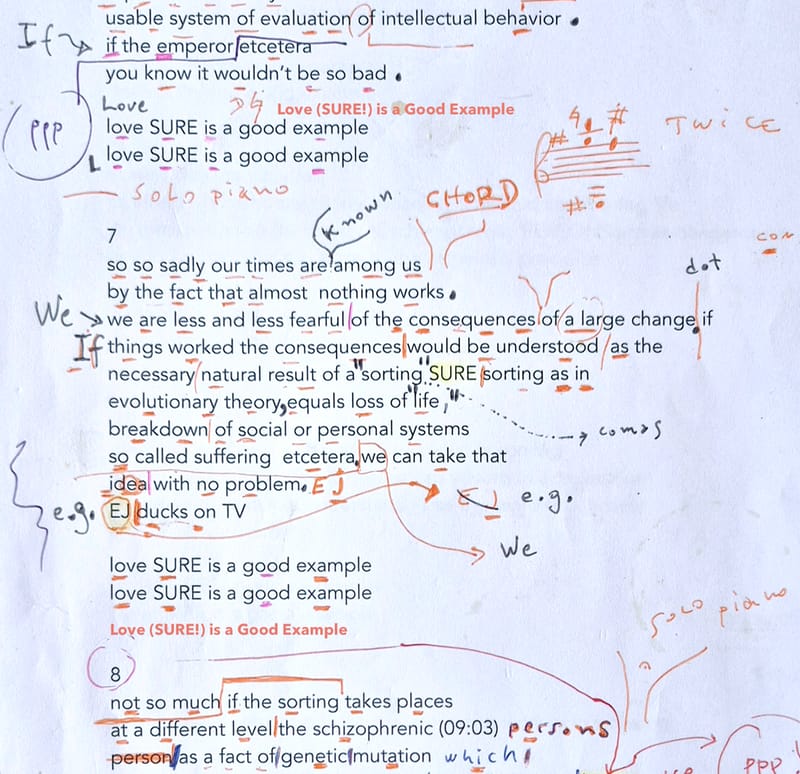
The two works on this CD are part of Baroni’s ongoing compositional practice, in which recorded speech is set against acoustic and electronic pitched sounds. The instrumental material emerges entirely from digitally aided speech analysis, which identifies occurrences of Western scale pitches within the natural intonations of speech. From these detected pitches, Baroni selects and assigns certain tones to instruments and electronics. The scores consist of the written speech text paired with musical notes, precisely aligned with the syllables from which they were drawn. Performers listen to the recorded speech and play the notes accordingly, resulting in instrumental sounds that synchronously “shadow” the speech. This situation alternates with interludes in which instruments more or less freely replay constellations of pitches from the most recent text phrase — a kind of abstracted echo. In live performance, the speech text is simultaneously projected on a large screen.
J’ai Connu features an excerpt from “Essay Mémoire Xxe” (2022) by essayist Géraldine Schwarz.. It was originally conceived and realised as a collaboration between Baroni, Schwarz, and filmmaker Sebastian Díaz Morales. The essay is a first-person narration — an empathetic yet deeply analytical and critical contemplation on the urgency of humanity. Written during the Corona pandemic, it is informed by the historical, ideological, ethical, and existential struggles of the 20th century. The whispering voice, reminiscent of ASMR practices, brings the text very close to the ear and pulls the listener into the “safe zone” of intimacy. Here, the analytical insights and difficult truths sound compassionate and humble. In spite of their gravitas, they do not paralyse the listener. The whisper of the voice instead amplifies the inherent relationality of Schwarz’s text, which emphasises the shared humanity between writer and reader.
Re-Genetic Mutations is an homage to Robert Ashley’s solo voice piece “Love Is A Good Example” (1991), and incorporates the full original recording. The text resembles an inner monologue: an erratic flow of thoughts that continually break up, while certain words return in a refrain-like manner. The narration resists comprehension, yet it resonates through its fidelity to the nonlinearity of thinking itself. Ashley’s speech is abundantly musical — where semantics fail to deliver, the sheer materiality of his voice and the musicality of his speech transform it into more than a transfer of meaning and information. Clearly articulated words and phrases oscillate between being meaningful and meaningless, opaque and transparent, intimate and general, with the intensity of a personal address.
Baroni engages with these two sophisticated and radical texts, yet his listening is not focused on their semantic registers. In his compositional procedures he does not interpret, comment, explain, reinforce, conceptualise, or illustrate the meaning they narrate. In this sense, the semantic integrity of the texts remains untouched by sound. Instead, by drawing out the musicality of speech, he loosens words from their primary function as semantic vessels and highlights them as temporal and sonorous events. Words become sonic landscapes marked by instrumental sounds that together form passing musical constellations. An environment emerges in which the core elements of speech — meaning, sonority, musicality — momentarily drift apart. Through disassociation and synchronicity, each element becomes more pronounced: meaning becomes more meaningful, sonority more sonorous, music more musical. Each element is foregrounded, yet each exists in its own autonomous dimension. Nevertheless, due to their synchronicity and proximity, they unbind each other from their own canons and contexts.
For example, besides carrying meaning, the sound of words is heard as the source of tonal constellations, granting them a musical coherence that does not rest on established canons. The instrumental constellations, on the other hand, are sometimes heard as guiding the speech. This is particularly the case in Re-Genetic Mutations, where Reinier van Houdt’s precise and subtle piano playing comes so close to the contours of Robert Ashley’s speech that it occasionally gives the impression of preceding, rather than following it. Such fluid, simultaneous, and at times contradictory relations among the elements form an open field that invites unfixed listening: an act of attention that does not aim toward recognition or understanding, but instead stimulates listening as wondering, exploration, and appreciation of vast and perpetual openness, established by the unhinged possibilities of the relations between elements. This openness is neither boundlessly amorphous nor fixed and permanent. It is located in the zone of excessive nearness and difference between words, voice, music, and listening.
— Tao G. Vrhovec Sambolec, Amsterdam, 22 september 2025.
Credits
J’ai Connu
Text: Géraldine Schwarz
Voice: Isabelle Vigier
Electric guitar: Jeroen Kimman
Piano: Reinier van Houdt
Bass: Dario Calderone
Electronics and tape: Claudio F. Baroni
Re-Genetic Mutations
Lyrics and voice: Robert Ashley
Piano: Reinier van Houdt
Tapes: Claudio F. Baroni
Based on “Love Is A Good Example” (1991) by Robert Ashley. Ashley’s voice was recorded at Roulette, NY, March 12, 1993 and published by Einstein Records in 1995. Re-Genetic Mutations was made possible thanks to the generous permission of Mimi Johnson.
DIGITAL ALBUM ON BANDCAMP

Biographies
Claudio F. Baroni
A key area in Baroni’s compositional work is the realm of the voice. Rather than the singing voice, he focusses on the spoken voice, the voice that simply narrates, inspired by the pioneering work of the American composer Robert Ashley. Baroni’s interest lies not only in the content of the words or the narrative of a text but also in the unique modulations that bestow identity upon the voice that “performs” it, information that he applies to compositional procedures.
Baroni studied piano and acoustic at the Universidad de Humanidades y Artes de Rosario, Argentina, and composition at the Royal Conservatory in The Hague, the Netherlands, with Clarence Barlow, Gilius van Bergeijk, and Louis Andriessen. He has collaborated on many multimedia projects with artists from different disciplines, including Joost Rekveld, Adi Hollander, Geraldine Schwarz, Fabian Marcaccio, Sebastian Diaz Morales, and Reinaldo Laddaga. Baroni is artistic director of the experimental contemporary music Festival Echonance.
This album is Baroni’s fourth collaboration with Unsounds records.
Géraldine Schwarz
Robert Ashley
http://www.robertashley.org/biographical/biography.htm
Reinier van Houdt
RE-GENETIC | Claudio F. Baroni
- Catalogue #: 90U
- Format: CD
- Release date: 2025
- Availability: In Stock
-
€12.00
Related Products

MOTUM (CD) | Claudio F Baroni
"Motum" means motion, and this is a central theme in the 3 pieces by composer Claudio F Baroni on this album. The concept is central to Baroni's work,..
€10.00

THINGS THAT A MUTANT NEEDS TO KNOW | Reinaldo Laddaga
A collection of fifty-five short tales and fifty-five brief musical works composed by a momentary collective of eighteen musicians. Texts Reinaldo L..
€20.00

THINGS THAT A MUTANT NEEDS TO KNOW (Digital, English) | Reinaldo Laddaga
Digital release of Unsounds 38U. English version. For iBook and iPads. Unsounds releases an ambitious project where text and music go hand in hand as..
€15.00
Tags: Claudio F Baroni, Robert Ashley, Reinier van Houdt, piano